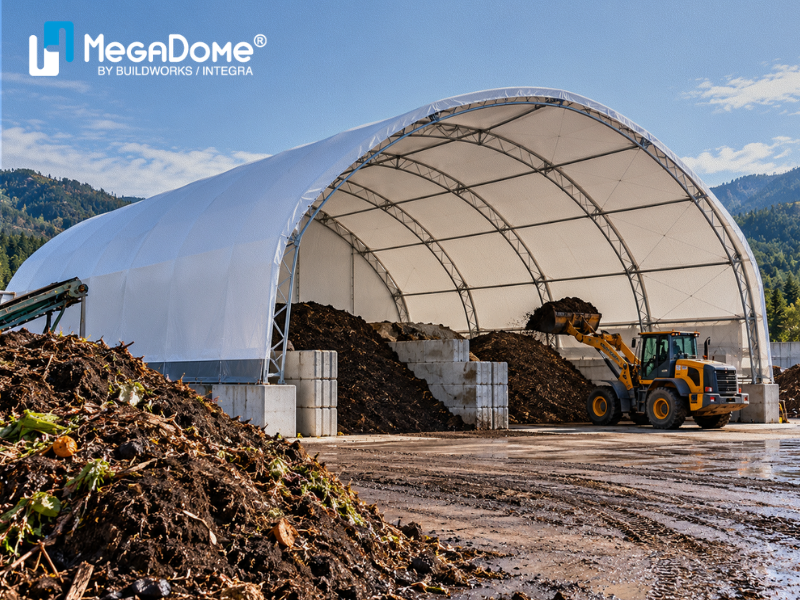
Composting facilities need more than simple covered space.
They require buildings that can handle moisture, material movement, equipment access, ventilation, changing storage volumes, and day-to-day industrial operations.
That is why many operators consider composting facility buildings built with engineered fabric structures.
Fabric buildings can provide large, open interiors without interior columns, giving loaders, trucks, conveyors, and material-handling equipment more room to operate. They can also be designed with ventilation, corrosion-resistant steel systems, large doors, and clear-span layouts suited to compost processing and storage.
For businesses operating across British Columbia and Western Canada, the right structure can help protect materials from weather while keeping the interior flexible for active composting operations.
Fabric buildings are commonly considered for composting operations because they can provide:
These features can make industrial fabric building solutions practical for composting facilities that need open, durable, and adaptable working environments.
Composting operations often involve large volumes of material.
Facilities may need room for:
Interior support columns can interfere with the movement of equipment and make it harder to reorganize material piles.
A clear-span fabric structure avoids many of these restrictions.
Without interior columns, operators can use more of the available floor area and move heavy equipment more freely.
This makes clear-span layouts especially useful for facilities where storage volumes or material placement change regularly.
Material handling is a major part of composting operations.
Loaders may need to move between different piles, transport material to processing equipment, and load finished compost into trucks.
A building with narrow aisles or interior structural columns can make this more difficult.
Industrial fabric structures can provide wide interiors that support:
The ability to create a flexible layout can improve the efficiency of daily operations.
Ventilation is one of the most important considerations in composting environments.
Compost processing can generate:
A building should therefore be designed with suitable airflow.
Ventilation options may include:
The right ventilation system depends on the size of the building, processing method, equipment, and operational requirements.
This is why ventilation should be planned as part of the building design rather than treated as an afterthought.
Composting facilities can create humid environments.
Moisture may come from the composting process itself as well as from rain, washing, or general operations.
The building membrane protects the interior from outside weather while the ventilation system helps manage interior conditions.
For fabric buildings in British Columbia, moisture management is especially important because many areas of the province experience significant rainfall.
The complete building system including membrane, ventilation, drainage, foundation, and steel protection should be designed around the facility’s operating conditions.
Composting environments can be demanding on structural materials.
Humidity, moisture, and the nature of composting operations can make corrosion resistance an important consideration.
This is where galvanized steel fabric buildings can offer an advantage.
Galvanized structural components can provide additional protection against corrosion compared with untreated steel.
For facilities operating in challenging environments, the appropriate corrosion-protection system can help improve the long-term durability of the structure.
The level of protection should be selected based on the actual application and site conditions.
Yes, depending on the building profile selected.
Composting operations may require clearance for:
Building height should therefore be considered carefully during planning.
A higher-clearance fabric building can give operators more flexibility in how equipment and materials are arranged inside.
It can also support larger storage piles without requiring a larger overall building footprint.
Yes.
Bulk material storage is one of the strongest fabric building applications.
Compost facilities often need to store large volumes of feedstock and finished material.
A clear-span interior allows operators to create large storage zones without working around columns.
This can make it easier to:
This flexibility can be particularly valuable for facilities with seasonal fluctuations in material volume.
Some fabric membranes allow natural daylight into the building.
This can create a brighter working environment during the day and may reduce reliance on artificial lighting in certain areas.
For large industrial buildings, natural light can improve visibility for operators moving equipment and materials.
However, the membrane specification should still be selected based on the overall building requirements, including durability, weather performance, and intended use.
Yes, provided the building is properly engineered for the project location.
Fabric buildings in BC should be designed around local conditions such as:
British Columbia has a wide range of environmental conditions, so one building design may not be appropriate for every region.
A composting facility on the coast may have different requirements from one in the Interior.
Site-specific engineering helps ensure that the structure is designed for the actual conditions of the project.
Yes.
One of the major advantages of fabric structure solutions is that the building can be configured around the operation.
Customization may include:
A facility that mainly stores finished compost may have different requirements from one that performs active processing.
A custom approach helps ensure the building works with the operation rather than forcing the operation to adapt to the building.
Before choosing a building, operators should consider:
These questions help determine the right commercial fabric building solution for the project.
No.
Fabric buildings can support several stages of a composting operation.
Depending on the design, they may be used for:
This flexibility makes them useful for both expanding facilities and new composting operations.
Fabric buildings are used for composting facilities because they can provide the wide, flexible, and durable space these operations require.
Clear-span interiors allow loaders, trucks, and processing equipment to move without unnecessary obstructions. Ventilation systems can support better airflow, while galvanized steel options can provide added protection in demanding environments.
For composting businesses in British Columbia and Western Canada, properly engineered composting facility buildings can offer a practical solution for material storage, processing, equipment access, and changing operational needs.
The best building is one designed around the specific site, material volumes, equipment, ventilation requirements, foundation conditions, and environmental loads of the project.
They provide large clear-span interiors, flexible material storage, equipment access, ventilation options, and customizable building configurations.
Yes. Composting operations can produce heat, humidity, odours, and airborne particles, so proper ventilation should be considered during building design.
Yes. The open interior space allows facilities to create large material piles, adjust storage zones, and move loaders efficiently.
Corrosion protection can be important in humid or aggressive environments. Galvanized steel may provide additional protection depending on operating conditions.
Yes, when the structure is properly engineered for local snow, wind, rainfall, foundation, and site conditions.
Yes. Width, height, ventilation, doors, foundations, corrosion protection, and other features can be configured around the operational needs of the facility.
Please complete this form to receive a
your FREE Design Guide.
Please fill out the form below to request to quote.