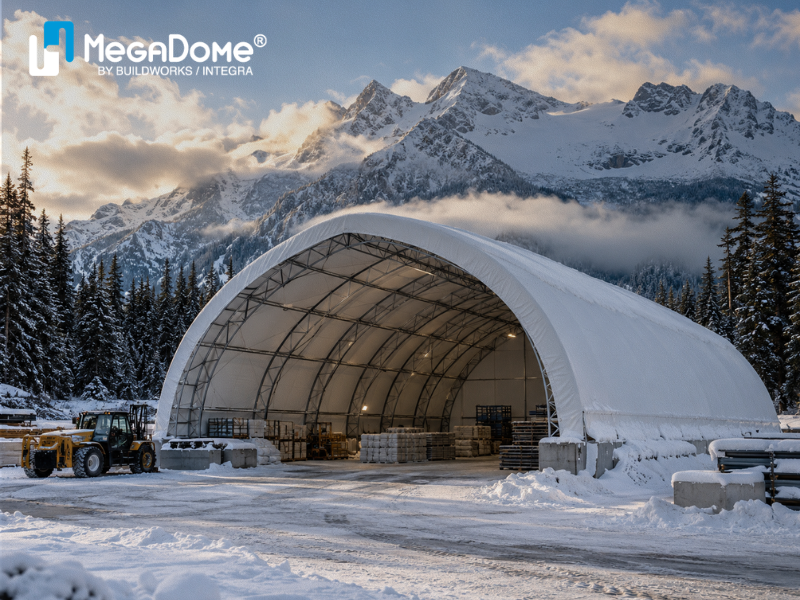
British Columbia has a wide range of climates. Coastal areas experience heavy rainfall and moisture, while interior and northern regions can face significant snowfall, freezing temperatures, and strong winds.
For industrial and commercial businesses planning a new building, this raises an important question:
The answer is yes, when the building is properly engineered for the specific project location.
Modern fabric buildings in British Columbia are not simply lightweight shelters. Industrial systems are designed using engineered steel frames, structural calculations, site-specific load requirements, durable fabric membranes, and foundation systems intended to perform under demanding environmental conditions.
For businesses in lumber, composting, recycling, manufacturing, bulk storage, building materials, and general storage, the important factor is not just choosing a fabric building. It is choosing a structure designed for the exact site and operational requirements.
Yes. Properly engineered industrial fabric buildings can be designed to accommodate snow, wind, rain, and other environmental conditions found throughout British Columbia.
The key factors include:
A building designed for Vancouver may have different structural requirements than one located in the BC Interior or a heavy-snow region.
This is why site-specific engineering is essential.
British Columbia is geographically diverse.
A project on the coast may need to account for heavy rainfall, moisture, and wind exposure. A project in the Interior may have greater snow-load requirements. Northern locations may face colder temperatures and longer winters.
This means fabric buildings BC projects should not be treated as one-size-fits-all structures.
The building should be designed around:
Professional fabric building engineering in BC helps ensure that the structure matches the environmental demands of the project location.
Snow load is one of the most important engineering considerations for buildings in many parts of British Columbia.
The roof and steel frame must be capable of carrying the expected snow loads for the site.
This involves considering factors such as:
An engineered fabric structure uses the steel frame to transfer loads through the structure and into the foundation.
The fabric membrane works as the building envelope, while the frame carries the primary structural loads.
For this reason, fabric building structural design is a critical part of the project.
Businesses should avoid comparing buildings based only on appearance. Two structures that look similar may have very different engineering specifications.
Yes, when they are properly designed for the application.
Steel frame fabric buildings combine structural steel framing with tensioned fabric membranes to create large, functional interior spaces.
The steel frame provides:
This makes engineered fabric buildings suitable for many industrial and commercial applications.
For example, businesses may use them for:
The structural frame should be selected and engineered according to the building size, span, height, and location.
Wind is another major consideration in industrial building engineering in British Columbia.
Wind loads can vary depending on the building location, exposure, height, and surrounding terrain.
A properly engineered fabric building takes these factors into account during structural design.
The building’s frame, membrane tension, connections, and foundation work together to resist wind forces.
This is why professional engineering is especially important for larger structures and exposed industrial sites.
A generic building package may not be appropriate for every location.
The building should be designed for the actual conditions expected at the site.
Rain is a major factor in many areas of British Columbia, particularly coastal regions.
A tensioned membrane system helps create a weather-resistant building envelope that directs water away from the interior space.
The roof shape, membrane tension, drainage planning, and site design all influence water management.
For businesses storing lumber, building materials, equipment, recyclable materials, or bulk products, keeping the interior protected from weather can be a major operational benefit.
A properly designed fabric structure can provide large covered areas without requiring interior columns that interfere with storage and equipment movement.
The membrane is a key component of the building system.
Industrial fabric membranes are designed for outdoor exposure and should provide suitable resistance to:
The quality of the membrane matters.
For commercial and industrial buildings, the membrane should be selected based on the expected service conditions.
Some fabric systems also allow natural daylight into the building, which can reduce the need for artificial lighting during daytime operations.
This can be useful in warehouses, recycling facilities, lumber yards, and general storage buildings.
Moisture is an important consideration for industrial buildings.
Coastal environments, composting operations, recycling facilities, and high-humidity applications may create more demanding conditions for structural steel.
This makes corrosion protection an important part of the building specification.
Galvanized steel fabric buildings can provide improved resistance to corrosion compared with untreated structural components.
Depending on the project, additional corrosion protection may also be appropriate.
This is especially relevant for:
The right protection system can help support long-term durability.
Even the strongest frame needs the correct foundation.
The foundation transfers structural loads into the ground and anchors the building.
Foundation requirements may vary depending on:
Different projects may use concrete foundations, grade beams, piers, or other engineered systems.
A professional building provider should evaluate the foundation as part of the complete project, not as an afterthought.
Yes.
Fabric buildings can be used in colder climates when the complete structure is properly designed.
Cold-weather performance depends on the application and building specification.
Businesses should consider:
A storage building may have different requirements from a manufacturing facility where employees work throughout the day.
The building design should match how the facility will be used.
One of the biggest advantages of engineered fabric structures is flexibility.
They can provide wide, open interior space for industrial and commercial operations.
This is especially useful where businesses need:
Clear-span space can reduce interior obstructions and make the building easier to use.
For lumber yards, recycling facilities, compost operations, manufacturing plants, and building material suppliers, this can improve operational efficiency.
Yes. Fabric buildings in Western Canada are used for many commercial and industrial purposes.
The important point is that the structure should be designed for the specific location.
Western Canada includes very different climate zones, so snow, wind, rain, temperature, and soil conditions can vary significantly.
A properly engineered structure should account for local environmental conditions instead of relying on a generic design.
Before moving ahead, businesses should ask questions such as:
These questions make it easier to compare building solutions accurately.
So, are fabric buildings suitable for British Columbia’s snow and weather conditions?
Yes, provided they are properly engineered.
A successful project depends on more than the membrane itself. The complete system steel frame, structural design, foundation, connections, corrosion protection, membrane, and site-specific engineering must work together.
For industrial and commercial businesses throughout British Columbia, engineered fabric structures can provide durable, flexible, and practical building space for storage, manufacturing, recycling, composting, lumber, equipment, and material-handling operations.
The most important step is choosing a building designed specifically for the project location and intended use.
Yes, properly engineered fabric buildings can be designed for local snow-load requirements. The structural frame, building profile, and foundation should all be designed for the specific project location.
They can be. Coastal projects should consider rain, moisture, wind, and corrosion exposure when selecting structural steel protection and building components.
Yes. The steel frame provides the primary structural strength, while the fabric membrane forms the building envelope. Durability depends on the engineering, materials, corrosion protection, and installation quality.
Industrial and commercial projects commonly require structural design based on the building size, site conditions, snow loads, wind loads, and local requirements.
Yes. Clear-span fabric buildings are commonly suited to bulk storage, lumber, equipment, building materials, recycling, and other industrial uses because they can provide large unobstructed interior space.
Yes. Building profile, steel framing, foundations, membrane systems, ventilation, corrosion protection, and other features can be selected according to the project’s location and intended use.
Please complete this form to receive a
your FREE Design Guide.
Please fill out the form below to request to quote.